|
Yugnopavitam
paramum pavitram
prajapateyrth
sahjam purastat
ayusham agrim
pratimoincha shuibrem
yugnopavitam
balam astu tejah
By Pushkarnath Nehru
1. What is Upanayana?
Upanayana is one of the most important
SAMASKARAS (symbolic events) in the life of the child.
In the ancient times a child was initiated into the
pursuit of secular knowledge (like astronomy, mathematics, metaphysics, logic,
medicine and other vedic literature) as well as into the realm of spiritual
development by putting him on the task of learning and practicing such
disciplines by way of his parents handing him over to a Guru for the purpose of
learning and practicing them under his guidance. But eventually this institution
became out of vogue due to the socio-economic changes. The Upanayan ceremony is
now restricted to and revolves around the investiture of the sacred thread or
the ‘yugnapavit’ and the teaching of Gayatri Mantra to the child.
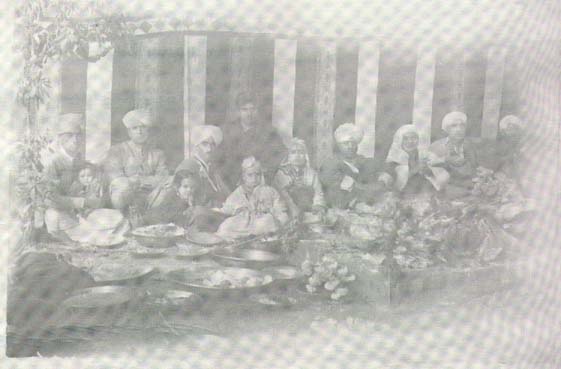
Cultural Nostalgia
Maekhal (Yugnopavit) around 1940s.
By virtue of the performance of the Upanayana
ceremony, which connotes the taking of the charge of the student by the teacher,
the student is supposed to have second birth (Dvija) in the world of knowledge
through education. This is done after staging symbolically all the previous
events (Samaskaras) right from his or her birth. In the Vedic birth of the
student, symbolised by wearing the “girdle” and the sacred thread, Savitri
becomes the mother and Guru the father.
2. What is Yugnopavit (sacred thread) ceremony?
This initiation of a student by the teacher, entailed
various functions, such as selection of Guru, auspicious time, preparation,
wearing of garments, the girdle, the sacred thread (“Yugnopavit”),
presenting of deer skin, the staff, Savitri Mantra, sacred fire (agnihotra)
and alms etc. Later on when the conception of Upanayana underwent a change
in the course of time, the mere initiation of the child by the teacher became a
sacred lore. The original idea of initiation for education got overshadowed by
the mystic significance of Upanayana which lead to the idea of second birth (dvija)
through the Gayatri Mantra. The initiation, which marked the taking
over of the charge of the student by the Guru, revolved around the establishment
of connection between the student and Savitri (through the Gayatri
Mantra) performed by the Guru and his teaching of this mantra.
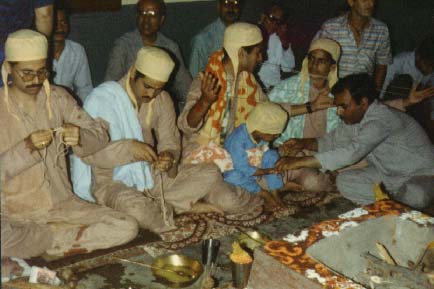
The Upanayana in the present form is the investiture of
the sacred thread (“Yugnopavit”) on the child which involves the
initiation and symbolically staging all the said Samaskaras. The most important
part of this ceremony is the wearing of the sacred thread and the accompaniment
of the recitation and teaching of the Gayatri (Savitri) Mantra which is
one prayer that is the crux of the whole vedic wisdom.
The wearer of this thread is supposed to be constantly
reminded of his commitment to the secular and spiritual goals which he has set
upon himself on this solemn occasion. That this life may not pass away just in
unconscious striving but become a means of the expansion of our ‘being’; That it
may provide a view of one’s self and the world without being in conflict with
the action that comes by ; That life, even at its worst, may still provide us a
source of sharing the joyousness of our existence; This is the greatest art of
life, which comes, not through wanton experimentation, but through prayer and
humility alone and through that the divine grace.
Abiding by the secular obligations towards his Guru, his
family and the society are some of the definitive prescriptions that cannot be
separated from his spiritual goals. Firstly the sacred thread has three folds
which represents the trinity of existence symbolizing the three worlds; Earth,
Space and the Heaven or Brahma (the unfolding of the world and this life),
Vishnu (the sustenance) and Mahesh (the re-absorption). The central knot of the
sacred thread and tying together of the three strands, represents Parambrahma
(the supreme expansion of consciousness) into which all the three ‘tattvas’
(aspects of Godhead) such as Brahma, Vishnu and Mahesh merge. This knot is
known as ‘Brahmagranthi’. The three cords remind the wearer that he has to pay
the three debts he owes to the ancient seers (rishis), the ancestors (pitras)
and the Devatas and that his consciousness has to expand into all the
three worlds. The threads are doubled at the time of marriage signifying the
additional sacramental obligations towards his consort.
3. Gayatri Mantra (also called Savitri)
The focal point of the whole Upanayana ceremony is the
recitation of the Gayatri Mantra and teaching its essence to the initiated. The
mantra is considered to be the most sacred and according to Manu ‘there
is nothing more exalted than the Gayatri’.
Om tat savitur
varenyam
bhargo devasya
dhimahi
dhiyo yo nah
pracodayat
This original ‘Gayatri Mantra’, which is also
known as ‘Savitri’, is a Rigvedic hymn (RV III, 62-10) which usually is
preceded by the recitation of ‘Om Bhur, Bhuvah Svah’ which upon
translation connotes :
Om bhur bhuvah
svah
tat savitur
varenyam
“That splendid magnificence of Savitre, the Cosmic
Sun, permeating the three worlds, the Earth, the Space and the Heavens is
assuredly Savitri; the inspirer, life giver, the stimulative force"
Bhargo devasya Dhimahi
“May we meditate on the life giving divinity, Savitri
assuredly is God, and therefore I meditate on his splendor”.
dhiyo Yyonha prochudayat
“May He himself illumine our intelligence. May He himself
breath it into us”.
The Gayatri Mantra derives its name from the metre in
which it is written, the Gayatri being a Vedic poetic metre of 24 syllables of
which, as per tradition, is authored by the sage Vishvamitra. The
mantra consists of three sections (PADS) having eight syllables each and
have to be recited in a particular sequence. Therefore the Gayatri Mantra
is not a magic formula nor is it merely a logical sentence. It connects in a
very special way the objective and subjective aspects of reality. It is neither
a mere sound nor sheer magic. Words have not only sound but also meaning which
is not apparent to all those who simply hear the sound. Such living words have a
power that transcends the mental plane. To acquire this energy of the word one
has to grasp not only its meaning but also its message, or its vibrations, as
they are sometimes called in order. Therefore the phonetic quality of the
mantra demands that it be recited in a particular way. Faith, understanding
and physical utterance as well as physical continuity (since the mantra
is supposed to be handed down by a master) are the essential requisites. Every
word links up with the source of all words. The ultimate character of the word (Shabada
Brahma) is a fundamental concept in spirituality.
4. Abhid (the alms)
The alms giving (Abhid) is now a symbolic act reminiscent
of ancient institution of obtaining voluntary contributions made for the
sustenance of the Guru’s Ashram in which the initiated students used to
study. Presently during the Yugnopavit ceremony the act of alms giving is
symbolically staged and is known as Abhid. This has now taken the complexion of
“Dakshina” for the presiding Guru.
5. Relevance of Yugnopavit in the present times
The Yugnopavit ceremony used to be one of the most
exalted functions in the life of a Brahmin, particularly in respect of the
Kashmiri Brahmins. But due to major changes in the social and economic factors
its importance in the course of time has significantly dwindled. In recent times
it has lost its vitality and sublimity. It has unfortunately now been reduced to
a social “Tamasha” without any attempt by us to restore its former
sanctity. This sacrament used to be one of the most important instruments for
inculcating and imparting discipline, values of life and the principles of right
conduct.
Now, in the aftermath of our exodus from Kashmir it is
doubly important to try and restore the intrinsic sanctity and usefulness of
this samaskara so that we are able to give a worthy gift unto the young.
Whereas modern education with its scientific spirit and vocational training is
important for our children, but at the same time cultivation of matrices of
right conduct, overall personality development with humane values of life so as
to develop a vibrant ethos are the very essential credentials that would enable
us to face the challenges of the present world. At present our children are
facing a cultural cul-de-sac which suggests a drifting and a meaningless
existence.
A sense of direction is needed more than ever before. The
infusion of the spirit behind the “Yugnopavit” ceremony which also aims
to promote compassion, love, benevolence, non-violence, fraternity,
self-discipline and finer human relationship etc. in addition to the urge to
meditate on the resurgence of the Supreme Consciousness can act as one of the
most important instruments for achieving this goal.
The intrinsic message of the Gayatri Mantra
engulfs a wide gamut of ideals such as what the Isha Upanishad says:-
Yastu sarvani
bhutanyatmanayay vamu pashyeti
sarva bhuteshu
ch atmanam tato na vijugupsate
yasiman
sarvani bhutanyatmyvabhdi janatah
tatra ko moha
kah shokah eikatva manupashytaha
“He who sees all creatures in himself, himself in all
creatures, does not show abhorrence to any one; knowing all beings to be ones
own-self and seeing the unity of man-kind, how can there be for him delusions,
sufferings and sorrows”.
Source: Kashmir
Sentinel
|