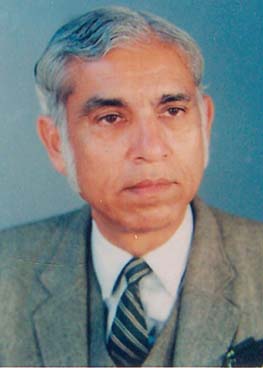
Pandit Sheo Prasad Kak “Mahjoor”
A unique conscience keeper of the society
By Dr. B.N. Sharga
It is generally believed that
the Kashmiri Pandits are self-centred people with inflated egos so they do not
accept anybody as their leader. Here we should keep in mind that exceptions do
not make a rule. It is a general weakness that we all suffer from the importance
bug even though we may be important only in our own estimation. Our holy
scriptures have defined this weakness as consciousness of the body and we should
be intelligent enough to analyse the difference between feeling important and
feeling good by doing something important. So, one should learn to do important
things in life but at the same time one should also feel humble, which alone
will ultimately lead us to all round progress and development. Pt Sheo Prasad
Kak realized this philosophy of life in ample measures and became a conscious
keeper of the society by his deeds and actions.
Pt. Sheo Prasad Kak’s
ancestors according to famous Kashmiri historian Mohammed Fauq were highly
religious and orthodox people. As they used to worship Kak
Bhusandi a mythological character and were dark complexioned so they were
nicknamed as Kak.
Although there are some other
views as well over the origin of this surname. His ancestor Pt. Sundar Kak had a
son Pt. Prabhakar Kak Raina who was originally a resident of Kulgam tehsil in
the Anantnag district of the
Kashmir
Valley. He had a son Harsh Kak and a grandson Prakash Kak who in turn had a grandson
Anand Kak. Pt. Anand Kak migrated from Kulgam to
Srinagar
and started living in Rainawari. He had three sons Jag Kak, Gobind Kak and
Vishan Kak. Pt. Jag Kak had three sons, who were Kora Kak, Sunder Kak and Mahesh
Kak. Pt. Kora Kak had two sons Durga Prasad and Mehtab Rai Kak, whereas Pt.
Sunder Kak had three sons Shambhu Nath, Sheo Prasad and Bhola Nath.
It has been reliably learnt that
Pt. Sunder Kak came to the imperial capital
Delhi
from
Kashmir
around 1806 during the rule of Mughal emperor Shah Alam-II (1759-1806) and
started living in Bazar Sita Ram,
Delhi
with his family members. Later on his nephew Durga Prasad who was the son of
his elder brother Pt. Kora Kak also joined him. Pt. Durga Prasad Kak had his
education in
Delhi
College
and then joined the
East India
Company.
Pt. Sunder Rai Kak in due course
of time got an employment in the Mughal Army and became a Bakshi to distribute the salary to the soldiers. He had three sons
Shambhu Nath, Sheo Prasad and Bhola Nath besides a daughter Indrani who was
married Pt. Mehtab Rai Kaul Sharga of Kashmiri Mohalla,
Lucknow
. Pt. Mehtab Rai Kaul Sharga was a post master during the British period. He had
two sons Kanhiyya Lal Kaul Sharga and Moti Lal Kaul Sharga besides four
daughters. His eldest daughter was married with Pt. Gauri Shanker Sopori and the
youngest daughter was married with Pt. Jawahar Lal Dar whose son Iqbal Kishan
Dar later on became the accountant general in the Jammu & Kashmir state.
Pt. Mehtab Rai Kaul Sharga took
premature retirement from service due to falling eyesight, but he succeeded in
getting his son in law Pt. Gauri Shanker Sopori appointed as a post master in
his place. Pt. Gauri Shanker Sopori had a son Pt. Hari Shanker Sopori who had
three sons Shyam Prasad Sopori, Shiv Shanker Sopori and Shyam Shanker Sopori.
Pt. Shyam Prasad Sopori was born in 1870. His son Pt. Tapeshwar Nath
Sopori(b-1906) migrated to
Delhi. He was married with the daughter of Pt. Pyare Lal Hukku.
Pt. Shiv Shanker Sopori was born
around 1882. He migrated to Chhapra in
Bihar
. He had a son Pt. Anand Narain Sopori (b-1901) besides two daughters Bimla
married to Pt. Chandra Mohan Nath Kunzru of
Agra
and Kamla married to Pt. Someshwar Nath Dar of
Kanpur.
Pt. Shyam Shanker Sopori was
born in 1890. He migrated to the Alwar state. He was married with Umashuri
(b-1895) who was the daughter of Pt. Brij Mohan Prasad Fotu.
He had three sons Iqbal Shanker,
Triloki Nath and Banmali besides six daughters Susheel Kumari, Kishan Kumari,
Savitri, Kavitri, Vidya and Pushpa.
Pt. Mehtab Rai Kaul Sharga’s
both the sons Pt. Kanhiyya Lal Kaul Sharga and Pt. Moti Lal Kaul Sharga had
their education and training under the tutelage of their maternal uncle Pt. Sheo
Prasad Kak, who was a great conscience keeper of the community at that time.
Pt. Durga Prasad Kak as
mentioned earlier was sent by the British to the
Bhopal
state around 1843 as a Vakil of the
East India Company during the rule of Sikander Begum there who was a woman of
Afghan descent and became her tutor and mentor.
The
Bhopal
state was founded by Dost Mohammed Khan a tribal warlord of Tirah, belonging to
the Mirzai Khel of the Barakzais who came to
Delhi
from
Afghanistan
in 1708 to seek employment in the court of Mughal emperor Bahadur Shah I
(1707-1712).
In 1709 he obtained the lease of
Berasia pargana and rapidly extended
his territory and founded the towns of Islam Nagar and
Bhopal. He built the Fatehgarh fort and later on declared himself as an independent
ruler by adopting the title of Nawab.
In 1720 he developed some
problem with the imperial Nazim but soon sorted out by sending his illegitimate
son Yar Mohammed Khan to
Hyderabad. Dost Mohammed Khan died around 1740 at the age of about 60 years. He was
succeeded by Yar Mohammed Khan whose rule was uneventful. He died in 1754 and
was succeeded by his son Faiz Mohammed Khan who was a religious recluse quite
unfit to rule. So, the state came under the administration of a Hindu Baiji Ram
who later on surrendered half of the
Bhopal
state to Peshwa Baji Rao of
Nagpur.
Faiz Mohammed Khan died
issueless in 1777 and was succeeded by his brother Hayat Mohammed Khan who was
also a religious recluse and incapable ruler. He adopted four Hindu boys a
Gonda,a Gosain and two Brahmins and made them his chelas.
He brought up all these four chelas as
Muslims.
In 1778 the Hindu Gond boy who
assumed the name Faulad Khan became a minister and helped the British Colonel
Goddard of the East India Company on his famous march from Bengal to
Bombay. After the death of Faulad Khan in 1779, Mamullah who was the widow of Yar
Mohammed Khan then appointed one of the Brahmin chelas
of Hayat Mohammed Khan as the minister to run the state. This Brahmin boy
assumed the name of Chhote Khan and died in 1798. After his death the
Bhopal
state witnessed bad days and came into the control of the Pindaris and Scindias
of Gwalior.
Wazir Mohammed Khan a cousin of
the Nawab then saved the state in 1807 by taking over the control of the
Fatehgarh fort. In 1813 again the combined forces of
Gwalior
and
Nagpur
attacked the
Bhopal
state which was defended for eight months with courage and determination. In
1816 Wazir Mohammed Khan died and was succeeded by his second son Nazar Mohammed
Khan whose wife Kudsia Begum became all powerful in the administrative matters
of the state. She had a daughter Sikander Begum. She deliberately delayed the
marriage of Sikander Begum till 1835 to hold the reins of power. Her son in law
Jahangir Mohammed Khan, who was the husband of Sikander Begum then hatched the
conspiracy in 1837 to over throw Kudsia Begum to usurp the power of the
Bhopal
state. The British then settled
this family feud after which Kudsia Begum took retirement on a life pension of 5
lac rupees in the
Bhopal
currency. This way the British developed their foothold in the
Bhopal
state in 1837 and opened their political department there in 1843.
Here it should be kept in mind
that during the rule of Nazar Mohammed Khan (1816-1819) a huge royal mansion
known as Gauhar Mahal was built in
Bhopal
as the residence of the royal family members. Later on structures like Nazar
Mahal, Bibi ki Masjid, Gauhar Masjid, Kudsia Bagh and Dewan-e-Am etc were added
into the premises of this royal complex. In the recent renovation work of this
complex understanding by INTACH some Hindu idols were discovered which gives a
hint that Gauhar Mahal was erected on the ruins of a 11th century
temple built by the Parmar ruler king Bhoj of
Dhar state in that area.
Nawab Jahangir Mohammed Khan
died in 1844. He had a desire that his illegitimate son Dastgir Mohammed Khan
should be made the ruler of the state but the British refused to recognize him
as such and in his place the claim of Nawab Jahangir Mohammed Khan’s
legitimate daughter Shahjahan Begum from his legally wedded wife Sikander Begum
was recognized by the British, who thus became the first woman ruler of the
Bhopal
state. A tug of war then began over the sharing of the power between the mother
Sikander Begum and her daughter Shahjahan Begum, which was resolved by the
daughter by resigning all her powers in favour of her mother Sikander Khan till
her death in 1868.
The British sent Pt. Durga
Prasad Kak around 1843 as a Vakil of the East India Company to look after the
British interests in the political department at
Bhopal. Pt. Durga Prasad Kak came into close contact of Sikander Begu there and due to
his shrewd diplomacy and farsightedness he soon became her tutor and mentor.
Sikander Begum became so much pleased with his administrative acumen that she
granted him two villages in Islam Nagar as jagir besides a robe of honour but
with a condition that if he or any of his descendants would migrate from the
Bhopal
state to some other place then their property would be confiscated by the
government.
Pt. Durga Prasad Kak became a
righthand man of Sikander begum who was a woman of very strong character and
great administrative capabilities. On the advice of Pt. Durga Prasad Kak she
rendered valuable service to the British during the disturbances of 1857. Even
in the darkest hours of misfortune she never swerved for a moment from her
loyalty.This was ably recognized by the British by granting her the district of
Barasia in 1860, which was originally in the Dhar state. In 1862 a sanad
was granted to her permitting succession on the failure of natural heirs in
accordance with the Mohammedan Law.
Pt. Durga Prasad Kak then in
order to share his added responsibilities invited his sister’s younger son Pt.
Moti Lal Kaul Sharga from Kashmiri Mohalla,
Lucknow
to
Bhopal
and made him his assistant. When Pt. Durga Prasad Kak died Pt. Moti Lal Kaul
Sharga became the Vakil of the East India Company at his place. Pt. Moti Lal
Kaul Sharga then became a Mir Munshi of the Residency in the
Gwalior
state. After the death of his elder brother Pt. Kanhaiyya Lal Kaul Sharga he
moved to the Bharatpur state from
Gwalior. In 1874 Maharaja Mangal Sngh of Alwar appointed him as his Vakil to fight a
case to Mount Abu. He won the case and Maharaja Mangal Singh made him the
Tehsildar of Alwar. But due to bad health he again went back to Bharatpur. He
has no issue. In 1881 he adopted Pt. Amar Nath Sharga. Pt. Moti Lal Kaul Sharga
died a year later in 1882 at
Delhi.
Pt. Amar Nath Sharga had a
grandson Pt. Onkar Nath Sharga who was the first general secretary of the All
India Kashmiri Samaj when it was constituted for the first time in 1980 at
Allahabad
by Justice Pratap Narain Bakshi.
Pt. Durga Prasad Kak had no
issue. He adopted Pt. Sheo Prasad Kak who was the son of his uncle Pt. Sunder
Kak.
Pt. Sheo Prasad Kak after
completing his studies at the
Delhi
College
started his career as a clerk in the political department of the East India
Company. The British appointed him as a Mir Munshi of the superintendent’s
office in the
Ajmer
state. At that time the superintendent was functioning in the
Ajmer
state as the political agent of the governor general of
India
since 1832 in Rajputana i.e. from the time of Lord William Bentinck
(1823-1833). But when the British constituted a regency council in 1853 to run
the administration of the Bharatpur state during the minority of Maharaja
Jaswant Singh they brought Pt. Sheo Prasad Kak from
Ajmer
to Bharatpur and made him the Mir Munshi of the regency council there.
The northern part pf the
territory
of
Bharatpur
was in control of Tonwar Rajputs who were ruling over
Delhi
prior to the invasion of Mahmood of Ghazni. It then came into the control of
Mohammed Ghori at the end of the 12th century. The Mughal emperors
made this territory as part of their
Agra
province.
During the British period the
rulers of the Bharatpur state were Jats who claim their descent from Madan Pal a
Jador Rajput and the third son of Tahan Pal who was the ruler of Karauli in the
11th century. One of Madan Pal’s descendants Bal Chand it is said
had a Jat concubine and by her had two sons Bijay and Sijay who were not
admitted in the Rajput clan. Having no gotra of their own they took the name of
Sinsinwar from their
paternal village Sinsini about 8
miles from Dig. Their main job was plunder and loot. In 1718 the Jaipur chief
Sawai Jai Singh was sent with a big force by the Mughal emperor Farrukhsiyar to
expel Churaman from the
territory
of
Bharatpur
but he had to make peace with him. Churaman was succeeded by his son Mukham
Singh who ruled over this territory for a very short time as his cousin Badan
Singh invited Maharaja Sawai Jai Singh of Jaipur to attack. Thus Mukham Singh
could not face the battle and fled away from the scene. Thus in 1722 Badan Singh
was recognized as an independent ruler of the Bharatpur state.
Badan Singh ruled over the
Bharatpur state till 1775 after which his able and capable son Suraj Mal
succeeded him, who became a hero of the Jat power and won many battles. He met
his death in 1763 at the hands of a Mughal Squadron of horsemen while making a
foolhardy attempt to hunt in the imperial domains and was succeeded by his
eldest son Jawahar Singh, who was murdered at
Agra
in June 1768. After his death the decline of the Jat power started and a new
Rajput state Alwar came into prominence in the area.
Jawahar Singh’s immediate
successor ruled over Bharatpur for only nine months and was followed by his
minor son Kesari Singh. Newal Singh was appointed then as regent to look after
the state, but his brother Ranjit Singh revolted against him creating a lot of
confusion. The Mughal emperor Shah Alam-II then restored this
territory
of
Bharatpur
with addition of Dig in 1785 to Ranjit Singh, who became a faithful follower of
Daulat Rao Scindia and was rewarded in 1795 with the grant of three more
districts.
The early years of the 19th
century witnessed different battles between the British and Marathas for the
supremacy over each other. Ranjit Singh assisted
Lord
Lake
in 1803 in capturing
Agra
in the battle of Laswari near Alwar and was granted five additional districts
by the British. In 1804 the war broke out between the British and the forces of
Jaswant Rao Holker of
Indore. In November 1804 the routed troops of Holker took refuge in the fort at Dig.
Then followed the memorable siege of Bharatpur by the troops of
Lord
Lake
from 3rd January upto 22nd February, 1805. A peace treaty
was then signed by Ranjit Singh with the British on 17th April 1805
and he was made to pay an indemnity of 20 Lacs as the war compensation and the
territory was restored to him.
Ranjit Singh died in 1805 and
was succeeded by his sons Randhir Singh (1805-1823) and then Baldeo Singh
(1823-25) who left a minor son. Balwant Singh whose succession was recognized by
the British, but his cousin Durjan Singh put him in prison to capture power. The
British then to install the rightful ruler Balwant Singh on the throne sent a
strong contigent of 20000 troops under their commander-in-chief Lord Combermere
to deal with Durjan Singh firmly who was made a prisoner by the British and was
deported to
Allahabad, Balwant Singh after attaining the majority was made the ruler of the Bharatpur
state in 1835. He died in 1853 after which his minor son Jaswant Singh succeeded
him. Naturally to run the administration of the state properly a regency council
was formed in 1853 and Pt. Sheo Prasad Kak was made a Mir Munshi of the
political Agent there.
Pt. Sheo Prasad Kak stayed in
the Bharatpur state for a very short duration as he was called back again by Sir
Henry Lawrence to
Ajmer
who was the Agent of the givernor general in Rajputana at that time. Major
Morrison was the Political Agent at Bharatpur that time, who asked Pt. Sheo
Prasad Kak to provide some reliable person at his place before leaving for
Ajmer. Pt Sheo Prasad Kak then called his sister’s elder son Pt. Kanhaiyya Lal Kaul
Sharga from Kashmiri Mohalla,
Lucknow
and got him appointed as Mir Munshi at his place before leaving for
Ajmer.
Here it should be kept in mind
that
Ajmer
was strategically very important for the British as it had one of the biggest
army cantonments. It was a seat of power of the Pratihari rulers in the 10th
century. Their king Anang Pal founded
Delhi
originally at Anangpur and built Lal Kot and Suraj Kund. He brought the famous
Iron pillar to
Delhi. The last ruler of this dynasty Prithviraj Chauhan was defeated by Mohammed
Ghori in the second battle of Terain in 1192 A.D. After that Mohammed Ghori’s
slave Qutub-ud-Din-Aibak became the Sultan of
Delhi
who installed Prithviraj Chauhan’s son Govindraj Chauhan as the ruler of
Ajmer, which was originally founded by Raja Ajay Chauhan ruler in 145 A.D. who built
a fort on Taragarh hill.
The Mughal emperor Akbar annexed
Ajmer
around 1560 A.D. from Maldeo Rathore of
Gujarat
and made it a part of his Subah.
Jahangir received Sir Thomas Roe the ambassador of king James I of
England
at
Ajmer
in January 1616. In 1790 the force of Mahadji Scindia captured
Ajmer
which was ceded to the British by Daulat Rao Scindia thorugh a treaty signed on
25th June, 1818.
From 1818 upto 1832 the British
officers in charge o
Ajmer, who were called superintendents used to correspond first with the Resident at
Delhi
and then with the Resident in Malwa and Rajputana. It then came under the
administration of the then North Western Provinces till 1871. Mr. Wilder was the
first British superintendent of
Ajmer.
Col.
Dixon became superintendent of
Ajmer
in 1842 during whose tenure Pt. Sheo Prasad Kak joined his service as a head
clerk in his office and did commendable work in 1851 in the district during its
resettlement of boundaries.
Pt. Sheo Prasad Kak then became
a Vakil and used to go from
Ajmer
to
Mount
Abu
quite often to fight the cases as the place had the Residency of the Agent of
the governor general of
India
then and Pt. Sheo Prasad Kak was very close to Sir Henry Lawrence, who was
later on killed in a battle on 4th July 1857 in the siege of the
Residency at
Lucknow
.
Pt. Sheo Prasad Kak was a man of
great integrity and unflinching loyalty. So both Sir Henry Lawrence and Major
Morrison used to give him a great regard. Pt. Sheo Prasad Kak was a man of great
literary taste and had a very good knowledge of administration. He started
composing Urdu couplets quite early in life under the penname Mahjoor. Some of his compositions have been published in 1932 in the
second volume of Bahar-e-Gulshan-e-Kashmir.
The following Urdu couplets
composed by him will give an idea about the style of his poetry writing and his
choice of words to express his emotions.
Maikashi ka yeh rang hai us bin
Mauj hai sagar-e-sharab mein saanp
Kaun zalim hai khaimazan dil mein
Nazr ata hai tanab mein saanp
Mar gaye hum shamim-e-gesu se
The nishan mushk-e-naab mein saanp
Jan ko apni tera cheen zabin
Ho gaye aalam-e-etaab mein saanp.
In 1857 on May 28, two regiments of Bengal Infantry and a battery of Bengal
Artillery raised a banner of revolt at Nasirabad, and marched straight to
Delhi. The European residents of
Ajmer
were then protected by the soldiers of Bombay Cavalry. Pt. Sheo Prasad Kak
played a key role in keeping the village population away from this rebellion and
in running civil administration smoothly without any hindrance during that
turbulent period.
Pt. Sheo Prasad Kak was a great
philanthropist and a man of sacrificing nature. So, he used to command a great
respect in the community. He helped many of his community members in many ways
both financially and otherwise. But he had no son. His daughter was married with
Pt. Jia Lal Wattal, who was a deputy collector in the Bharatpur state. Pt. Sheo
Prasad Kak to continue his family lineage adopted his daughter’s son who then
became Pt. Brij Nath Kak. Pt. Sheo Prasad Kak was alive upto 1857. He died
suddenly there after due to a fall.
Pt. Sheo Prasad Kak’s adopted
son Pt. Brij Nath Kak after completing his education became a custom officer in
the state-service of
Udaipur
during the rule of Maharana Fateh Singh. He subsequently became the private
secretary of Maharana Fateh Singh and an honourable member of the state council.
He had four sons Bisheshwar Nath, Bishambhar Nath, Bishan Nath and Visheshwar
Nath. Pt. Bisheshwar Nath Kak after doing his M.A. became a deputy collector and
was posted at Etah in U.P. He had two sons Vishwa Bhushan Nath and Vishwa Nath.
Pt. Bishan Nath Kak after doing
his B.A. became an assistance excise commissioner. The British conferred the
civilian title of Rai Sahab upon him for outstanding services. He was married
with Munni (Bhagyabhari) who was the daughter of Pt. Bishambhar Nath Ghaughai
and the granddaughter of Justice Sahmbhu Nath Pandit who was the first Indian
judge of the Calcutta High Court.
Pt. Bishan Nath Kak had two sons
Brijendra Nath and Vigyanendra Nath. Dr. Brijendra Nath Kak became a qualified
medical doctor. He was married with Maharaj Kumari (Bitia) who is the daughter
of the famous Urdu poet Pt. Brij Narain Chakbast of Kashmiri Mohalla,
Lucknow
. Dr. Brijendra Nath Kak had two sons Dr. Vijay Kumar Kak who now lives in
Chandigarh
and Lt. Col. Raj Kumar Kak who now lives at 8A,
Tagore
Town,
Allahabad. He was the president of Allahabad Kashmiri Samaj a few years back. Now, he is
maintaining the legacy of this branch of the Kak family against heavy odds like
a lone warrior. We should not forget here that some people always believe in
optimism like Antony Chekhov who said long back that we
shall find peace. We shall hear angels. We shall see the sky sparkling with diamonds.
| 





 Download Book